This page last revised 30 August 2006 -- S.M.Gon III
Introduction
Ecoregion
Conservation Targets
Viability
Goals
Portfolio
TNC Action Sites
Threats
Strategies
Acknowledgements
▫
Tables
Maps & Figures
CPT Database
Appendices
Glossary
Sources
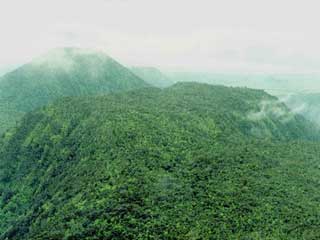
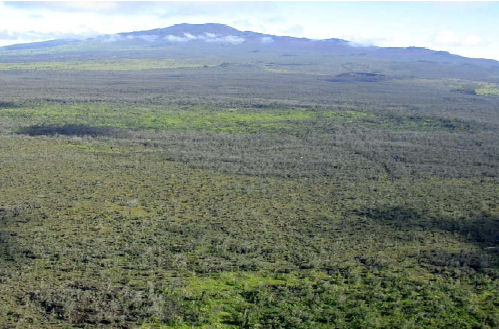
Large tracts of undeveloped mesic forest in the Kona Conservation Area.
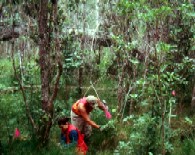
Portions of the Kona Hema Preserve have been rendered ungulate-free, and show significant recovery of native vegetation.
Appendix:
Hawai‘i Island Strategies
1998 ERP Strategic Summary
The 1998 ERP summarized strategies for thespecific needs of each ofthe conservation areas defined by the large native landscapes ofeach major island. The directives established then have largely beenrealized and continue to evolve. In 1998, the Hawai‘i IslandProgram, did not yet exist, and we managed no preserves there. The ERPrecommended thefollowing for Hawai‘i:
-
Windward slopes of Mauna Loa-MaunaKea and
· Sustain (lobby Congress for funding,facilitate community involvement, and assist with acquisition/partnershipnegotiations) active stewardship and restoration at Hakalau ForestNWR and adjoining state, Hawaiian Homelands, and private property to anchor thenorthern native-dominated vegetation on the windward flank ofMauna Kea. Ensure that this linkswith protection of high-elevation māmane-naio and other natural communities on
· Sustain active stewardship and restoration at Hawai‘i
· Encourage collaborative planning among the aboveparties, county Board of Water Supply, hunters, and other local communitymembers for the maintenance of native forest linking northern andsouthern anchor sites on windward Mauna Loa and Mauna Kea.
· Establish community-based stewardship programfor the Ka‘ū and Kapāpala state forest reserves and adjoining private lands toprevent weed invasion into this vast, relatively weed-free area of high-quality ecosystems. Ensure that this links with thepartnership in the Volcano region to sustain and restore forest connecting the two areas.
· Establish a partnership with Kona ranchers,other community members, the State, U.S. Fish and Wildlife Service, and federaland academic research organizations to jointly develop forest restoration tools for private implementation on grazed and loggedlands that still support important native forests. Include state lands at Pu‘uwa‘awa‘ain
· Through partnerships, develop incentives for private landowners to activelyconserve native species through tax reform, matching funds, and private-public habitat conservation plans based on therecently revised state endangered species act.
· Assist owners of key parcels in implementing forest recovery measures to prevent newbreaks in the upland Kona forest belt, and re-establish forest linkswhere necessary. This assistance mayfund stewardship under cooperativeagreement, or may include acquisition of the property for federal or TNCmanagement. Our preference is to assistprivate owners in managing and retaining their forest lands.
· Sustain (through Congress) the Army’s ecosystemmanagement program at Pohakuloa Training Area and ensure that this buildsappropriate habitat links and partnerships joining the Kona area with the
Kohala
· Work with our partners at Kahuā Ranch to developmodel forest stewardship programs that can be sustained by the Ranch itself,and which demonstrate a workable balance between removing feral pigs fromsensitive forests and maintaining a supply of huntable pigs for home use bylocal families.
· Help state and private forest owners andcommunity interests in developing a practical stewardship plan for thesite.
We believe the toppriorities for TNCH action are the Kona and Ka‘ū strategies listed above.
2006 Strategic Update
By the end of 2005, TNC had refined conservation area boundaries for Hawai‘i Island,recognizing Kohala, Mauna Kea, Windward Mauna Loa, Ka‘ū-Kapāpala,Kona, and Pōhakuloa-Pu‘u Wa‘awa‘a. See map below.
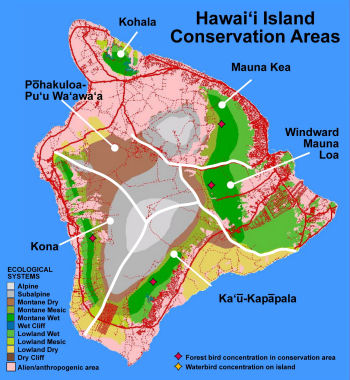
Selecting Kona and Ka‘ū-Kapāpala as high-priority areas,we made a series of acquisitions on Hawai‘i Island, establishing Kona Hema Preserve (8,061 acres in three contiguous units) in Kona and Ka‘ū Preserve(3,548 acres in four non-contiguous units). Kona Hema units have beenfenced and are approaching ungulate-free status. Ka‘ūPreserve is in the process of acquiring NAPP status. A Hawai‘i (Big Island) Programwas established and is growing toward implementing strategies forthe high-priority conservation areas of the island, and pursuit ofcooperative conservation of all viable portfolio areas with partners.
The Hawai‘i Island Program actively participates as a member of the ‘Ōla‘a-Kīlauea Management Partnership,and its expanded Three Mountain Alliance involving hundreds ofthousands of acres from the Kona and Ka‘ū flanks of Mauna Loa andthe summit region between them. We were an active agent in theacquisition of Kahuku Ranch, transferring the 116,000 acre parcel (the largest single conservation acquisition in Hawai‘i) to Hawai‘i Volcanoes National Park in 2003. We have assisted with management planning with Kamehameha Schools at Keauhou (Ka‘ū) (2004)
From 1999-2001, TNC worked toward a research and management partnership in the Pu‘u Wa‘awa‘aarea, but was not able to bring enhanced ungulate control to the area'slowland dry and mesic ecosystems. We maintain an partner/advisory rolethere.
We continue to encourage private landowners to engage in sustainable koa forest restoration in Kona, and are conducting research on koa silvicultureand its biodiversity impacts and benefits in Honomalino Unit of theKona Hema Preserve. Also pertinent to Kona efforts is our involvementin planning for sustainable recreational use of the Mauna Loa upland trail system.TNC is a partner in the Kohala Mountains Watershed Partnership, established in 2003. A watershed management planhas been completed and partners are collaborating in efforts to addressungulate problems in biologically rich forest on private and publiclands.