This page last revised 08 September 2006 -- S.M.Gon III
Introduction
Ecoregion
Conservation Targets
Viability
Goals
Portfolio
TNC Action Sites
Threats
Strategies
Acknowledgements
▫
Tables
Maps & Figures
CPT Database
Appendices
Glossary
Sources
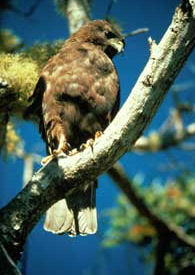
Lowland and montane mesic forest on Hawai'i Island are habitat for 'io, the Hawaiian hawk.
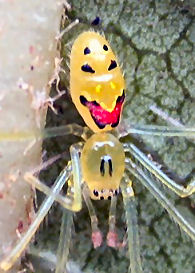
Anuntold number of native invertebrates, such as this Hawaiian happyfacespider, are nested within Hawai'is native ecosystems.
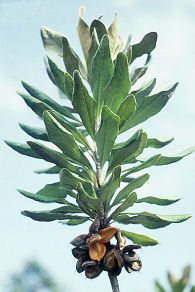
The endemic ho'awa, Pittsporum hosmeri, is restricted to Kona, and a food plant of the endangered Hawaiian corw, 'alala.
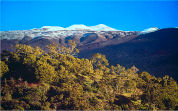
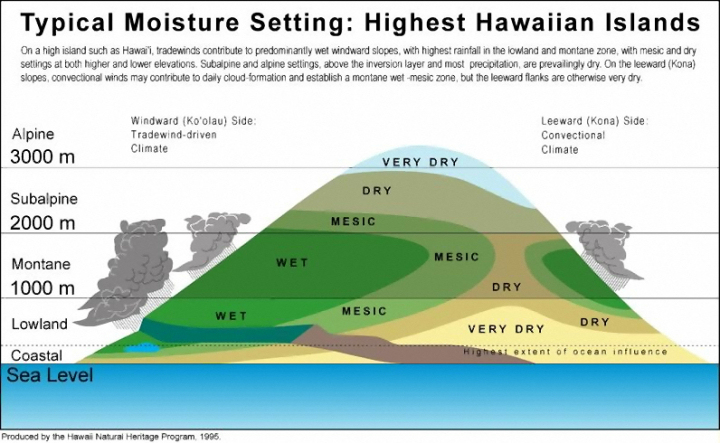
There is a wide variety of native ecosystems on the Island of Hawai'i.
Hawai‘i Island Conservation Area Profiles
Major Habitat Type: Tropical Moist
Stratification Unit:Island of Hawai‘i (comprised of multiple large shield volcanoes(Kohala, Mauna Kea, Mauna Loa, Hualālai, and Kīlauea); of recentgeological age (<450,000 years) and sharing biodiversity viageological history distinct from the older islands of the archipelago.
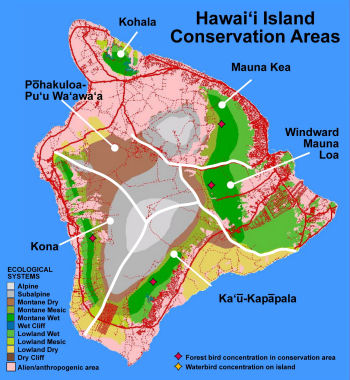
Island:Hawai‘i, largestisland of the archipelago, greater in area than all other islands ofthe archipelago combined; bearing the tallest mountains of theecoregion (e.g., Mauna Kea at 4,205 m (13,796 ft), and Mauna Loa at4,169 m (13,677 ft)). The native-dominated landscapes ofHawai‘i Island have been subdivided into five Conservation Areas(see figure below) corresponding to broad regions of the volcanicpeaks on the island. Approximately 140,000 human residents.
Significance: TheConservation Areas of Hawai‘i Island are comprised of ecologicalsystems from lowland to alpineelevations. The summit areas and large undeveloped upper elevationinterior sections maintain high viability systems, are importantwatersheds, and contain over 70 native natural communities. The island of Hawai‘i supports 248 Hawaiian endemic species of flowering plants, 25 of which are endemic to the island, and 39 of which are endangered.
ConservationStatus: The Conservation Areas of Hawai‘i Island are protected and managed by acombination of private and public protected areas, including Hawai‘i Volcanoes National Park, Manukā, Kīpāhoehoe, Pu‘u Maka‘ala, Waiākea, Laupāhoehoe, Pu‘u o ‘Umi, and Mauna Kea Ice Age StateNatural Area Reserves, Hakalau and Kona National Wildlife Refuges, The Kona Hema and Ka‘ū Preserves of The Nature Conservancy, the State Forest ReserveSystem, and the state Conservation District. The ‘Ōla‘a-Kīlauea Management Partnership,formed in 1991, is comprised of a combination of some of the above lands with lands ownedand/ormanaged by Kulani Correctional Facility (State) - 7,400 acres; Pu‘u Maka‘ala Natural Area Reserve (State) - 12,400 acres; National Park Service (NPS) - Hawai‘i Volcanoes National Park - 219,000 acres; Kamehameha Schools (KS) - 189,000 acres; U.S. Fish and Wildlife Service (FWS); U.S.G.S. Biological Resources Division; U.S.D.A. Forest Service, and The Nature Conservancy of Hawai‘i. The partners drafted a management plan that implementsfencing, ungulate control, and weed control, ignoring land jurisdictionboundariesand dealing with the major threats. Such actions are included in a discussion of conservation strategies for Hawai‘i.
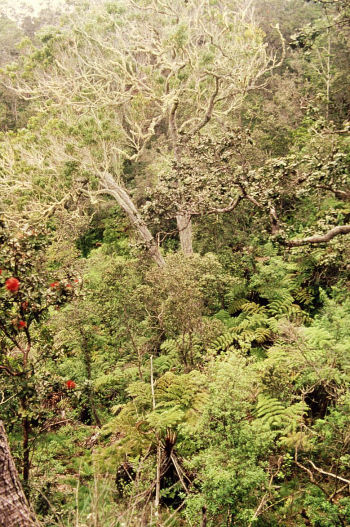
Montane Mesic Forest in Manukā Natural Area Reserve, Kona, Hawai'i
Ecological Systems: Nine ecologicalsystems of Hawai‘i Island are included amongthe conservationtargets of the different conservation areas, each bearing nestednatural communities and species. The overall viability ranks of thenine systems in the six conservation areas are summaried below.
| Conservation Area | ||||||
| System | KOH | MK | WML | K-K | KON | P-P |
| Alpine | - | VERY GOOD | - | VERY GOOD | VERY GOOD | VERY GOOD |
| Subalpine | - | GOOD | - | VERY GOOD | GOOD | VERY GOOD |
| Montane Dry | - | FAIR | FAIR | GOOD | GOOD | GOOD |
| Montane Mesic | - | FAIR | FAIR | GOOD | GOOD | FAIR |
| Montane Wet | GOOD | VERY GOOD | GOOD | VERY GOOD | GOOD | - |
| Wet Cliff | FAIR | - | - | FAIR | - | - |
| Lowland Wet | FAIR | FAIR | FAIR | FAIR | FAIR | |
| Lowland Mesic | POOR | POOR | FAIR | FAIR | FAIR | POOR |
| Lowland Dry | - | - | - | FAIR | FAIR | POOR |
Natural Communities:
- Continuous Perennial Stream Community
Special Ecological Features:
- Forest Bird Concentrations
- Waterbird Concentrations
- Natural Communities:
‘Ōhi‘a/Mixed
‘Ōhi‘a/Mixed Shrub Montane
‘Ōhi‘a/‘Ōlapa Montane
‘Ōhi‘a Mixed Lowland Mesic
Lama/‘Ōhi‘a Lowland Mesic
Lama Lowland Dry Forest
Hawaiian Montane Bog
Mixed Fern/Shrub Wet Cliff Community
Koai‘a Lowland Dry Forest
Koa/Māmane Montane Dry Forest
Māmane/Naio Subalpine Dry Forest
Pūkiawe Subalpine Dry Shrubland
Hawaiian Alpine Aeolian Desert
- Native species:
There are manyconstituent native species that comprise the natural communities of the ConservationArea. Highlights include 39 rare/endangered plant species, 248 endemicflowering plant species, and an untold number of endemic invertebrate species likelynumbering in the thousands.
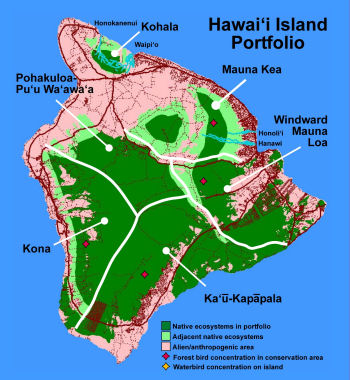
Major Threats:Uncontrolledferal ungulates (primarily pigs, goats, mouflon); a variety ofinvasivealien plants, including Pennisetum, Miconia, Clidemia, and Psidium, militarytraining impacts and wildfire at montane and subalpine dry and mesicsettings; logging and ranching in Kona and Mauna Kea conservation areas.The portfolio of conservation areas for Hawai'i(far right) includes viable ecological systems (dark green), fourforest bird concentrations (red stars), four stream communityoccurrences (light blue courses running from Kohala and Mauna Keaconservation areas), and waterbird concentrations (detailed localitiesnot shown at this scale).