This page last revised 05 September 2018 -- S.M.Gon III
Introduction
Ecoregion
Conservation Targets
Viability
Goals
Portfolio
TNC Action Sites
Threats
Strategies
Acknowledgements
▫
Tables
Maps & Figures
CPT Database
Appendices
Glossary
Sources
 Significant increases in state funding for natural area management will build needed capacity.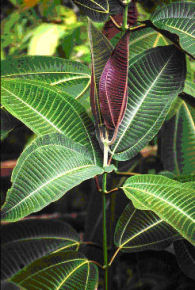
We have a tool to assess the risk for potential alien plant introductions to become weeds.
Strategies
In 2018 the strategies that were defined by this ecoregional plan were aligned to a set of over-arching global strategies expressed in the local ongoing work of The Nature Conservancy of Hawaiʻi.
We invite you to visit our website to learn more!
Strategy Overview [Archived]
Ecoregional strategies for the Hawaiian High Islands operate at two levels: 1) those applied over the entire ecoregion (multi-area strategies) with variations according to the enabling conditions at each conservation area in the portfolio, and 2) specific strategies planned and implemented for each conservation area in the ecoregion. Both levels are aimed ultimately at addressing the critical threats that erode the viability of conservation targets, allowing viability to stabilize and improve. In Hawai‘i this involves tools such as acquisitions and easements on significant lands, and active prevention and abatement of threats such as invasive alien species and fire, but also includes forging policy changes and building landscape-scale conservation partnerships.
Multi-Area Strategies
The
first iteration ecoregional plan (ERP 1998) established a set of conservation area strategies designed to abate critical threats to biodiversity within each of the large native-dominated landscapes across the archipelago (see Conservation Area Strategies). It also articulated three high priority multi-area strategies to be applied across the ecoregion, benefitting all conservation areas in the portfolio. These strategies have been implemented over the past 7 years with much success. ERA II builds on and continues these multi-area strategies, reported on below.
Strategy 1. Watershed Partnerships
Establish public-private land management partnerships in all portfolio conservation areas to implement cooperative landscape-scale management actions (i.e., threat abatement at scale). A watershed partnership map and list of partners is presented in the link below.
Major achievements to date:
» 12 partnerships have been established on six of the main islands involving all portfolio conservation areas;
» Umbrella entity Hawai‘i Association of Watershed Partnerships (HAWP) established;
» A total of ~890,000 ha (~2,200,000 acres) contained within partnership boundaries, with ~320,000 ha (~790,000 ac) (79%) overlap with the ERA II portfolio;
» A total of 71 public and private partners participating;
» Conservation management plans developed for all partnerships.
Next steps:
» See our Hawaiʻi TNC website for the latest!
Strategy 2. Increased State Funding and Management Capacity
Significantly increase funding/staffing support for management of priority watershed partnership and state-owned lands. Increase capacity for State Natural Area Reserves, Forest Reserves, and State holdings within public-private partnerships.
Major achievements to date:
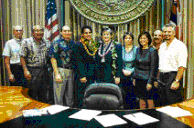
» In 2005, the State Legislature approved a major increase in the State conveyance tax rate and allocation of this revenue source for forest conservation programs, including watershed partnerships and State Natural Area Reserves; Act 156, via HB1308, 2005.
» In 2006, secured legislative approval to enact Act 156 with an increase in State conservation spending authority from $3.3M/year to $8M/year.
» In 2006, the State Legislature passed House Concurrent Resolution 200 requesting that "...the DLNR conduct an analysis of local, national, and international incentives...to promote protection of important mauka lands and recognize the public benefits of the ecosystem services provided by those lands."
» In 2012, the Governor launched the "Rain Follows the Forest" Watershed Protection Initiative to double the area of high priority watersheds fenced and under effective management. $5M was awarded by the Legislature in FY13, $8.5M in FY15 to achieve this goal.
Next steps:
» See our Hawaiʻi TNC website for the latest!
(continued next column)
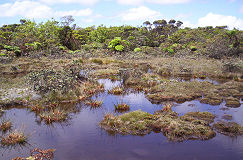
Native forest watershed is the ultimate source of all of the islands' freshwater.
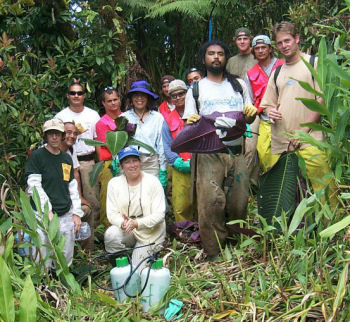
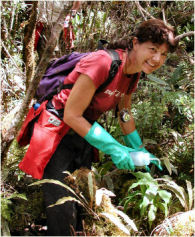
Maui Invasive Species Committee (MISC) Miconia control field team
(continued from previous column)
Strategy 3. Prevention of Alien Species
Establish a system to effectively prevent new introductions of invasive alien species, deal with incipient introductions, and contain/control established pests. Build additional capacity in all above areas.
Major achievements to date:
» In 2003, the State Legislature formed a cabinet-level Hawai‘i Invasive Species Council (modeled after the National Council);
» State funding secured for HISC prevention, early detection/rapid response, control, research, and outreach programs: FY05 $4M; FY06 $4M; FY07 $2M;
» Five
island invasive species committees (ISC) were established, covering early detection, rapid response, and control on all main islands.
» Hawaiʻi State Department of Agriculture (HDOA) received $2.9M and authority to hire 56 new staff positions in FY07 to implement a biosecurity strategy to prevent invasive species introductions through Hawai‘i ports of entry;
» Hawai‘i Weed Risk Assessment protocol moved from research to demonstration phase to assess invasive potential of new plant introductions;
» A pilot demonstration of model Codes of Conduct for minimizing noxious weed introductions with selected nursery/landscape industry leaders;
» Congressional legislation was introduced to provide Hawai‘i exemption from federal agriculture quarantine preemption on movement of potential pests.
» Legislative authority for HDOA to collect a cargo inspection fee to increase support for inspection and quarantine programs at ports.
» A portion of oil tax revenue to HDOA, to support invasive species prevention, and biocontrol research programs.
» The 2008 economic downturn drastically affected HDOA, which lost 25% of inspector and technician positions; positions are slowly being rebuilt as economy improves.
» Legislative support of $5M in FY15 general funds for HISC prevention, control, outreach and research programs.
Next steps:
» See our Hawaiʻi TNC website for the latest!
We use a TNC standard process, Conservation Action Planning (CAP), to identify the most important conservation goals and urgent actions for each specific conservation area:. The common actions include:
purchase or conservation easement
membership in a management partnership
Managing conservation areas
protective fencing of priority areas
feral ungulate control
priority weed control
predator control (e.g., rats, feral cats)
other threat control (e.g., wildfire)
Building capacity
staffing for specific goals
growth toward needed level
building partner capacity
Engaging partners
landowners within conservation area
agencies with conservation mandates
joint conservation planning
Building conservation support
community involvement
field visits to conservation areas
preparation of advocacy media
Measure conservation progress
establish monitoring system
assess results against CAP
Conservation strategies and actions for each conservation area are described in the Appendices.

