This page last revised 31 August 2006 -- S.M.Gon III
Introduction
Ecoregion
Conservation Targets
Viability
Goals
Portfolio
TNC Action Sites
Threats
Strategies
Acknowledgements
▫
Tables
Maps & Figures
CPT Database
Appendices
Glossary
Sources
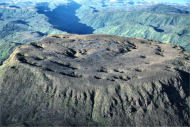
Montane bogs on the flat summit of Pu‘u Eke, West Maui Mountains.
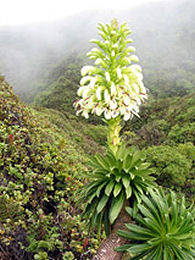
The remote and rugged habitat of West Maui is refuge for rare endemic plants and animals.
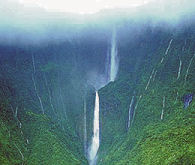
The highly-eroded West Maui Mountains boast spectacular wet cliff ecosystems.
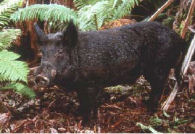
Non-nativepigs, escaped into the wild, pose a threat to native ecosystems, butare also a local food source.
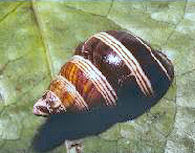
Anuntold number of native invertebrates, such as this endemic tree snail, are nested within West Maui native ecosystems.
WestMaui Conservation Area Profile
Major Habitat Type:Tropical Moist
StratificationUnit:Maui Nui (comprised of the islands of Maui, Moloka‘i,Kaho‘olawe, and Lāna‘i; of similargeological age and sharing biodiversity via geological history thatcombined all as a single large island during a lower stand of the sea).
Island:Maui; the second largestisland of the archipelago, its oldest volcano (West Maui Mountains orMauna Kahalawai) ca1.3 million years old , East Maui Volcano (Haleakalā) ca750,000years old and considered active (last historical eruption in 1790);maximum elevation of East Maui 3055 m(10,023 ft). Maui has two native-dominated landscapescorresponding to the two volcanic peaks on the island.Maximum elevation of the West Maui Mountains is 1,764 m (5,788 ft) atPu‘u Kukui. Approximately 140,000 human residents.
Significance: The West MauiConservation Area is comprised of ecological systems fromlowland to high montaneelevations. The summit area and undeveloped, steep terrainmaintain high viability systems, are animportant watershed, and contain over 20 nativenatural communities. West Maui supports over 150 Hawaiianendemic species of flowering plants, 12 of which areendangered.
ConservationStatus: The West Maui Conservation Area isprotected and managed by acombination of private and public protected areas, including fourseparate units of the West Maui StateNatural Area Reserve, TheKapunakea Preserve of The Nature Conservancy, The Pu‘u KukuiWatershed Management Area of Maui Land & Pineapple, the StateForest ReserveSystem, and the state Conservation District. The West Maui Watershed Partnership,formed in 1997, is comprised of a combination of the above lands withselected lands ownedand/ormanaged by the Maui County Board of Water Supply; Kamehameha Schools;C. Brewer and Company Limited; Amfac/JMB Hawaii, LLC; The NatureConservancy; Maui Land & Pineapple Co., Inc.; State Departmentof Land & Natural Resources; and the County of Maui. The partnersdrafted a management plan that implementsfencing, ungulate control, and weed control, ignoring land jurisdictionboundariesand dealing with the major threats. Such actions are included in a discussion of conservation strategies for Maui.
AWest Maui Conservation Area Plan is being drafted by The NatureConservancy and will be completed in 2008.
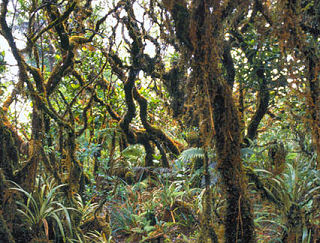
Epiphytic mosses in montane wet forest vegetation, West Maui
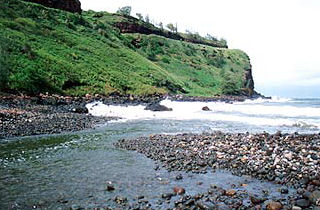
HawaiianContinuous Perennial Stream, Honokōhau Bay, West Mauii
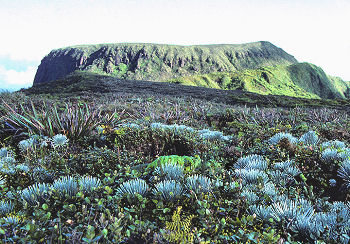
West Maui silverswords (Argyroxiphium calignis) near ‘Eke Crater(back).
ConservationTargets:
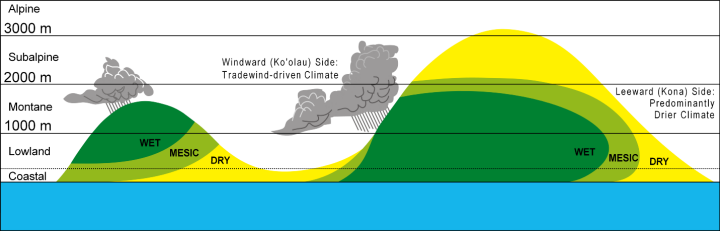
Ecological Systems: Five ecological systems of West Maui were selected as conservationtargets, each bearing nested natural communities and species (discussedbelow).
| System | Size | Condition | LC | Overall |
| MontaneWet | FAIR | VERYGOOD | VERYGOOD | GOOD |
| MontaneMesic | POOR | FAIR | GOOD | FAIR |
| LowlandWet | FAIR | FAIR | FAIR | FAIR |
| DryCliff | POOR | FAIR | FAIR | FAIR |
| WetCliff | FAIR | GOOD | GOOD | GOOD |
Natural Communities:
- ContinuousPerennial Stream Community
Special Ecological Features:
- WaterbirdConcentration
- Natural Communities:
‘Ōhi‘a/Mixed
‘Ōhi‘a/Mixed Shrub Montane
‘Ōhi‘a/‘Ōlapa Montane
‘Ōhi‘a Mixed Lowland Mesic
Lama Lowland Mesic
Hawaiian Montane Bog
Mixed Fern/Shrub Wet Cliff Community
Mixed Shrub Dry Cliff Community
Montane Piping Cave Community
- Native species:
There are manyconstituent native species that comprise the natural communities of theConservationArea. Highlights include 12 rare/endangered plant species, over 150 endemicflowering plant species, and an untold number of endemic invertebratespecies likelynumbering in the thousands.
MajorThreats:Uncontrolledferal ungulates (primarily pigs, goats,deer); a variety ofinvasivealien plants, and wildfire at lower dry and mesic settings.
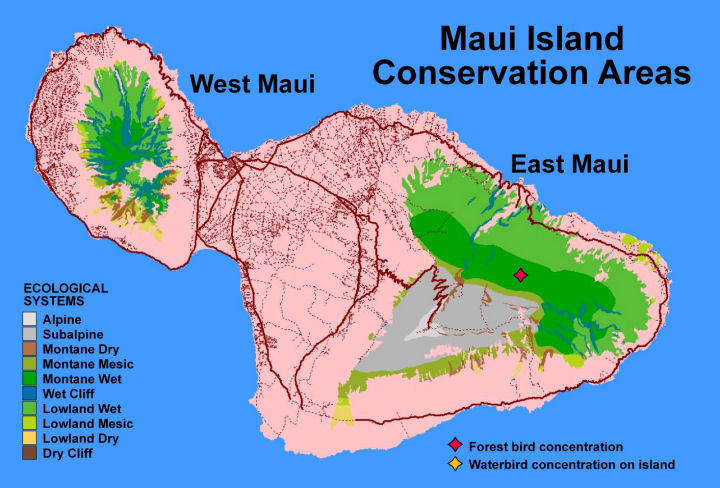
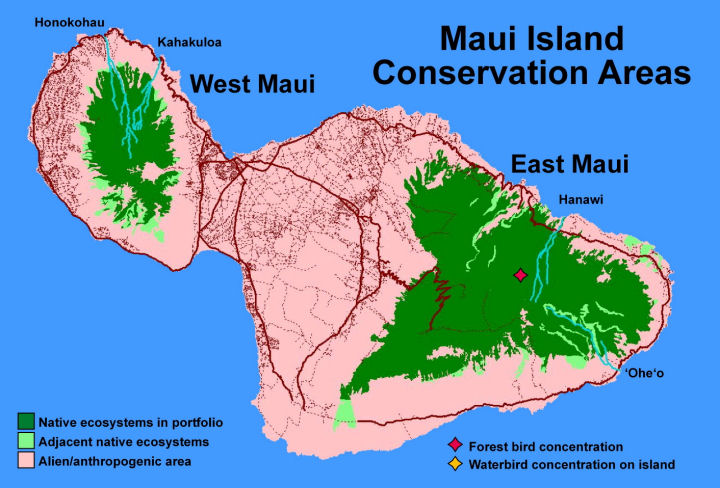
The conservationportfolio for West Maui includes the majority of the native dominatedecological systems (dark green) and two occurrences of the Hawaiian continuous perennialstream natural community (Honokōhau and Kahakuloa) shown in light blue.