This page last revised 31 August 2006 -- S.M.Gon III
Introduction
Ecoregion
Conservation Targets
Viability
Goals
Portfolio
TNC Action Sites
Threats
Strategies
Acknowledgements
▫
Tables
Maps & Figures
CPT Database
Appendices
Glossary
Sources
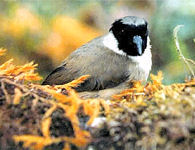
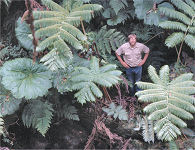
Montane wet forest on the windward slopes of East Maui are the last habitat for the po‘ouli.
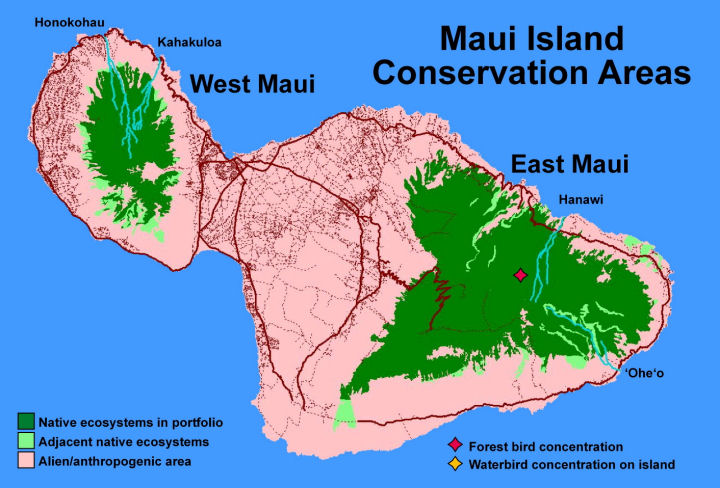
The East Maui Conservation Area includes large tracts of state-owned forest reserve.
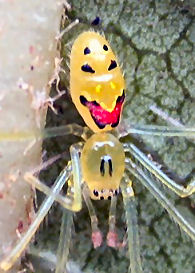
Anuntold number of native invertebrates, such as this Hawaiian happyfacespider, are nested within East Maui's native ecosystems.
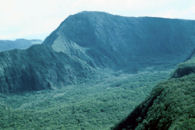
The rugged upper slopes of East Maui have never been converted from native forest.
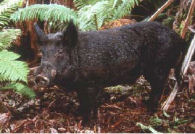
Non-native pigs, escaped into the wild, pose a severe threat to native ecosystems.
East Maui Conservation Area Profile
Major Habitat Type: Tropical Moist
Stratification Unit:Maui Nui (comprised of the islands of Maui, Moloka‘i,Kaho‘olawe, and Lāna‘i; of similargeological age and sharing biodiversity via geological history thatcombined all as a single large island during a lower stand of the sea).
Island: Maui; the second largestisland of the archipelago, its oldest volcano (West Maui Mountains orMauna Kahalawai) ca1.3 million years old , East Maui Volcano (Haleakalā) ca750,000years old and considered active (last historical eruption in 1790);maximum elevation of East Maui 3055 m(10,023 ft). Maui has two native-dominated landscapescorresponding to the two volcanic peaks on the island.Maximum elevation of the West Maui Mountains is 1,764 m (5,788 ft) atPu‘u Kukui. Approximately 140,000 human residents.
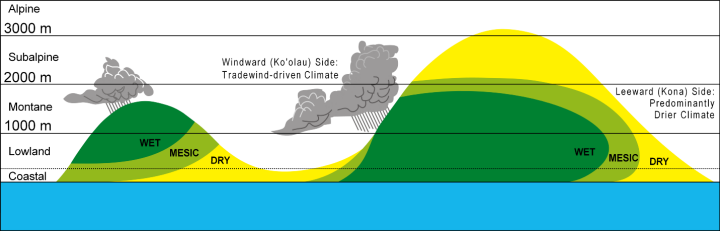
Significance: The East Maui Conservation Area is comprised of ecological systems from lowland to alpineelevations. The summit area and undeveloped northeast side maintain high viability systems, are animportant watershed, and contain over 20 native natural communities. East Maui supports over 530 Hawaiian endemic species of flowering plants, 54 of which are endemic to the island, and about 30 of which are endangered.
ConservationStatus: The East Maui Conservation Area is protected and managed by acombination of private and public protected areas, including Haleakalā National Park, Hanawī StateNatural Area Reserve, The Waikamoi Preserve of The Nature Conservancy, the State Forest ReserveSystem, and the state Conservation District. The East Maui Watershed Partnership,formed in 1991, is comprised of a combination of the above lands withselected lands ownedand/ormanaged by the State Department of Land & Natural Resources; TheNature Conservancy; Maui County Board of Water Supply; Haleakala RanchCo.; East Maui Irrigation Co., Ltd.; Haleakala National Park; HanaRanch; andthe County of Maui, drafted a management plan that implementsfencing, ungulate control, and weed control, ignoring land jurisdictionboundariesand dealing with the major threats. Such actions are included in a discussion of conservation strategies for Maui.
An East Maui Conservation Area Plan is being drafted by The Nature Conservancy and will be completed in 2007.
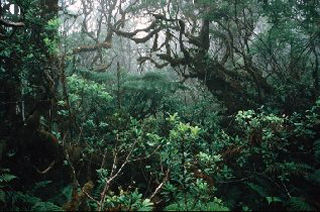
Montane Wet Forest, Hanawī Natural Area Reserve, East Maui
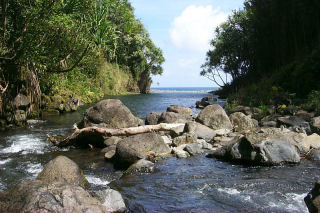
Hawaiian Continuous Perennial Stream, Hanawī, East Maui
Conservation Targets:
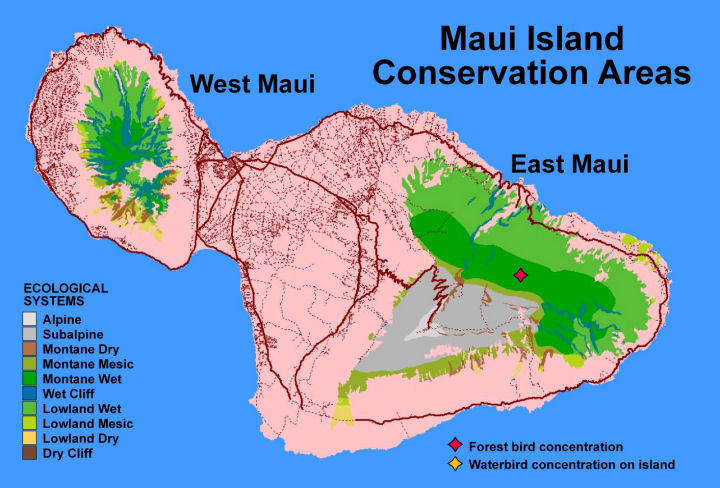
Ecological Systems: Four ecological systems of East Maui were selected as conservationtargets, each bearing nested natural communities and species (discussedbelow).
| System | Size | Condition | LC | Overall |
| Alpine | POOR | VERY GOOD | GOOD | GOOD |
| Subalpine | POOR | VERY GOOD | FAIR | GOOD |
| Montane Wet | GOOD | VERY GOOD | VERY GOOD | VERY GOOD |
| Lowland Wet | VERY GOOD | FAIR | POOR | FAIR |
Natural Communities:
- Continuous Perennial Stream Community
Special Ecological Features:
- Forest Bird Concentration
- Waterbird Concentration
- Natural Communities:
‘Ōhi‘a/Mixed
‘Ōhi‘a/Mixed Shrub Montane
‘Ōhi‘a/‘Ōlapa Montane
‘Ōhi‘a Mixed Lowland Mesic
Pleomele Lowland Mesic
Hawaiian Montane Bog
Mixed Fern/Shrub Wet Cliff Community
Mixed Shrub Dry Cliff Community
Montane Piping Cave Community
- Native species:
There are manyconstituent native species that comprise the natural communities of the ConservationArea. Highlights include over 30 rare/endangered plant species, over 50endemicflowering plant species, and an untold number of endemic invertebrate species likelynumbering in the thousands.
Major Threats:Uncontrolledferal ungulates (primarily pigs, goats, deer); a variety ofinvasivealien plants, including Miconia, Clidemia, and Psidium, and wildfire at lower dry and mesic settings. .