
This page last revised 05 January 2009 -- S.M.Gon III
Introduction
Ecoregion
Conservation Targets
Viability
Goals
Portfolio
TNC Action Sites
Threats
Strategies
Acknowledgements
▫
Tables
Maps & Figures
CPT Database
Appendices
Glossary
Sources
.
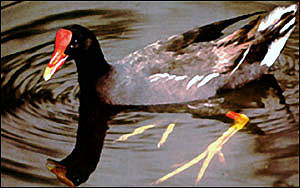
Waterbirdscomprise a unique conservation target based on geospatial concentrationsof species with special threats and management needs.
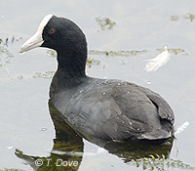
Hawaiian Waterbird Concentrations
The avifaunaassociated with Hawaiian wetlands have suffered a history of habitatdestruction, so that all native waterbird species and subspecies are now consideredthreatened or endangered (USFWS 2005). The endangered Hawaiian waterbirds include the Hawaiian stilt (‘ae‘o, Himantopus mexicanus knudseni), Hawaiian coot (‘alae ke‘oke‘o, Fulica alai), Hawaiian duck (koloa, Anas wyvilliana), and Hawaiian moorhen (‘alae ‘ula, Gallinula chloropus sandvicensis). 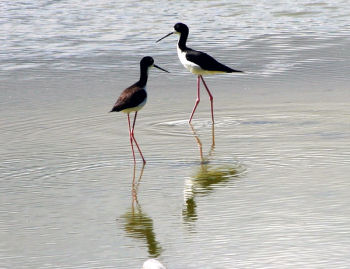
‘Ae‘o, or Hawaiian stilts (Himantopus mexicanus knudseni) are one of the
more resilient of our endangered waterbird species.
Waterbird concentrations as conservation targets were defined as anyassemblage ofindigenous and endemic waterbird species occupyinga wetland area recognized by state and federal conservation agencies.When the distribution anddensities of waterbirds were assessed across the ecoregion,concentrations emerged on the islands of Kaua‘i,O‘ahu, Moloka‘i, Maui, and Hawai‘i.

‘Ae‘o, or Hawaiian stilts (Himantopus mexicanus knudseni) are one of the
more resilient of our endangered waterbird species.
(continued next column)
Hawaiian Waterbird Concentrations
Waterbird concentrations involve all stratification units.The concentrations are well-distributed among islands. Most wetlandsites occur at coastal and lowland elevations, and the vast majorityare not dominated by native vegetation. Fortunately, waterbird speciesdon't seem to require native wetland vegetation.
Thusthe conservation areas defined by waterbird concentrations typicallylie outside of, and typically at lower elevations than nativeecological systems, and do not overlap with the conservation areasdefined by viable ecological systems.
We selected for the ecoregion portfolio 44 wetland sites identified inthe USFWS Waterbird Recovery Plan as "protected and primary wetlandhabitats," all of which must be protected and managed before anywaterbird species can be considered "recovered." This includes 16core and 28 of 37 (75%) of supporting wetland occurrences.
Maps of the Hawaiian waterbirdconcentrations included in the ecoreional portfolio, are available via the Hawaiianendangered waterbird recovery plan (USFWS 2005). The islands bearing portfolio waterbird concentrations are listed below.

Waterbird concentrations involve all stratification units.The concentrations are well-distributed among islands. Most wetlandsites occur at coastal and lowland elevations, and the vast majorityare not dominated by native vegetation. Fortunately, waterbird speciesdon't seem to require native wetland vegetation.
Thusthe conservation areas defined by waterbird concentrations typicallylie outside of, and typically at lower elevations than nativeecological systems, and do not overlap with the conservation areasdefined by viable ecological systems.
We selected for the ecoregion portfolio 44 wetland sites identified inthe USFWS Waterbird Recovery Plan as "protected and primary wetlandhabitats," all of which must be protected and managed before anywaterbird species can be considered "recovered." This includes 16core and 28 of 37 (75%) of supporting wetland occurrences.
Maps of the Hawaiian waterbirdconcentrations included in the ecoreional portfolio, are available via the Hawaiianendangered waterbird recovery plan (USFWS 2005). The islands bearing portfolio waterbird concentrations are listed below.
KAUAI STRATIFICATION UNIT
Ni‘ihau & Kaua‘i Islands
(5 core wetlands + 7 of 9 supporting wetlands)
O‘AHU STRATIFICATION UNIT
O‘ahu Island
(5 core wetlands + 10 of 13 supporting wetlands)
MAUI NUI STRATIFICATION UNIT
Maui, Moloka‘i & Lāna‘i Islands
(3 core wetlands + 5 of 7 supporting wetlands)
HAWAI‘I STRATIFICATION UNIT
Hawai‘i Island
(3 core wetlands + 6 of 8 supporting wetlands)
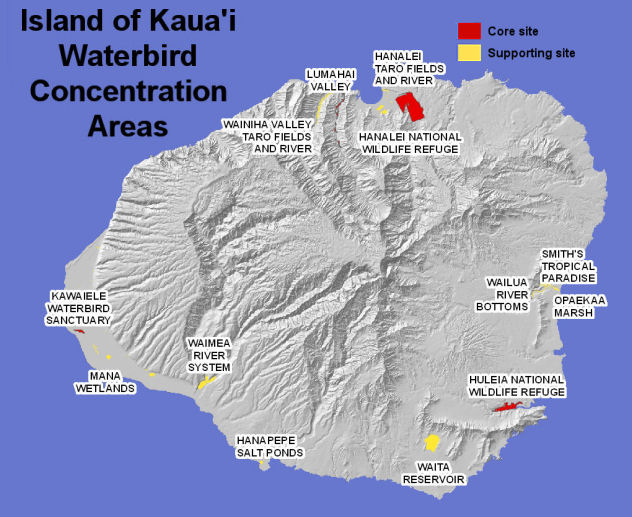
The five corewetlands of Kauai (shown in red above) are Lumaha‘i Valley,Hanalei taro fields and river, Hanalei NWR, Huleia NWR,
and Kawaiele Sanctuary. There are also numerous supporting wetlands (yellow).
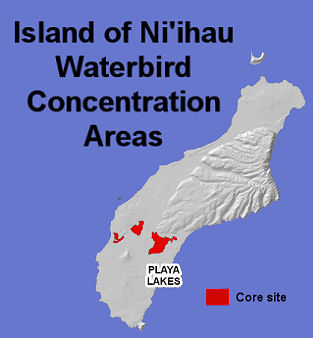
The playa lakes of Ni‘ihau comprise a core waterbird site.
O‘AHU STRATIFICATION UNIT:
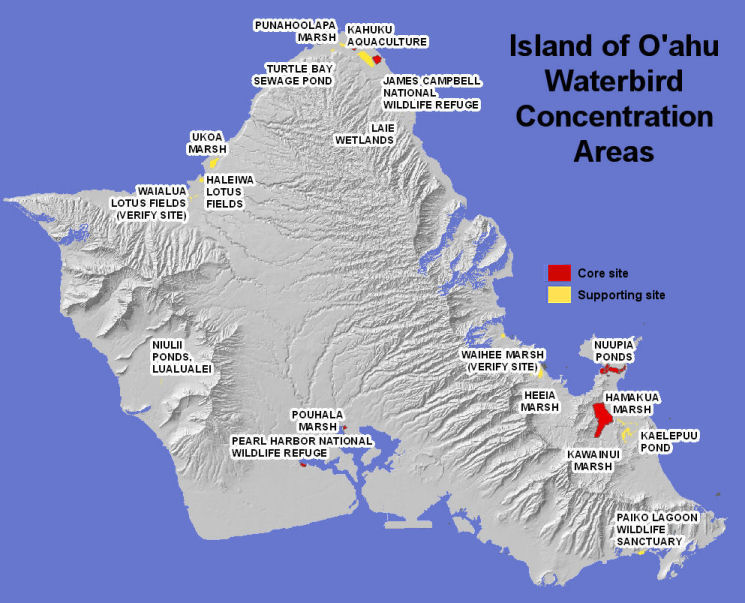
The five core wetlands of O‘ahu (red) are Pearl Harbor NWR,Pouhala Marsh, Kawainui Marsh, Nu‘upia ponds, and the JamesCampbell NWR. There are also numerous supporting wetlands (yellow)
MAUI NUI STRATIFICATION UNIT:
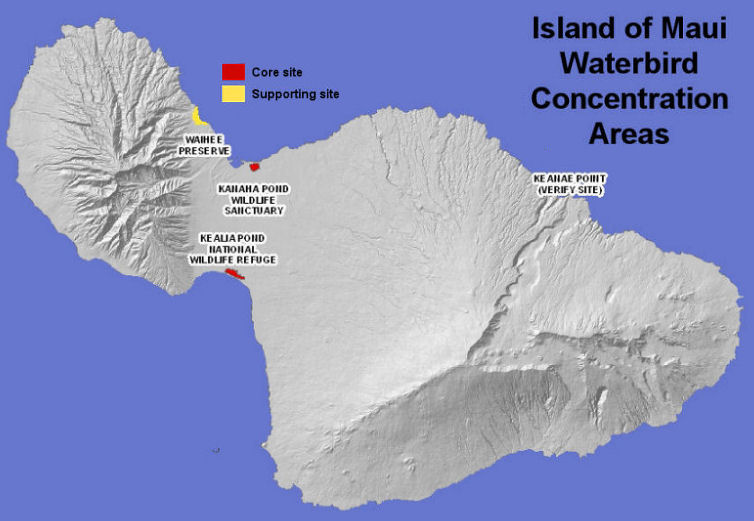
Two of the three core sites of the Maui Nui Startification Unit occuron Maui, at Kanaha Pond Wildlife Sanctuary, and Kealia Pond NWR.
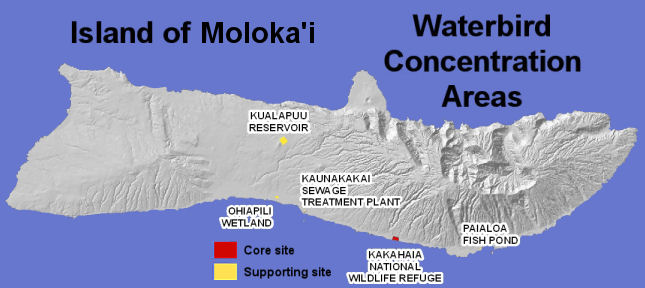
Moloka‘i includes one of the three core wetlands of the Maui Nui Stratification Unit: Kakahai‘a NWR.
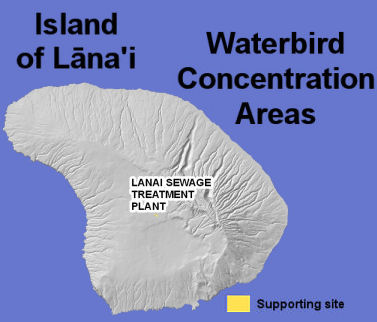
Lāna‘i island includes one small supporting site in the Maui Nui Stratification Unit.
HAWAI‘I STRATIFICATION UNIT:
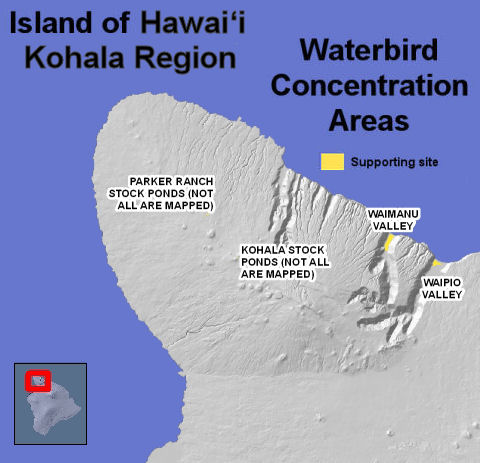
The Kohala Conservation Area includes no core wetlands, only supporting wetlands.
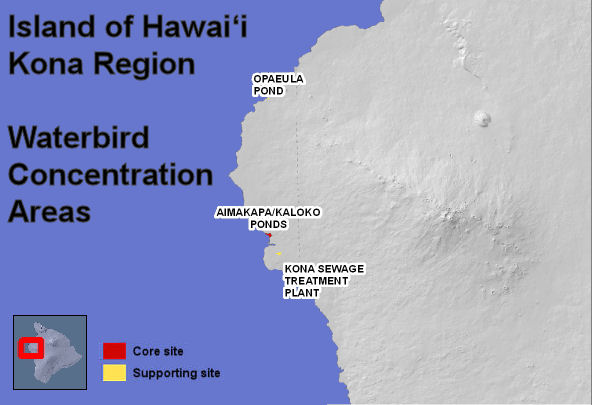
The Kona Conservation Area includes the core site ‘Aimakapā/Kaloho Ponds.
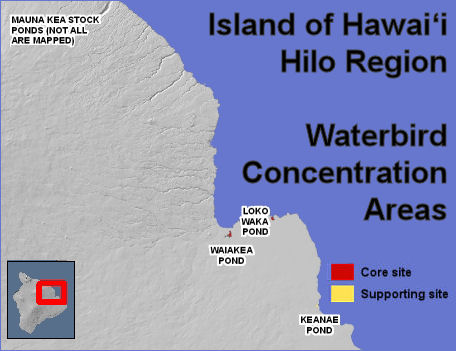
The Hilo region includes two core sites: Waiākea and Loko Waka. Ke‘anae is a supporting site.