This page last revised 31 August 2006 -- S.M.Gon III
Introduction
Ecoregion
Conservation Targets
Viability
Goals
Portfolio
TNC Action Sites
Threats
Strategies
Acknowledgements
▫
Tables
Maps & Figures
CPT Database
Appendices
Glossary
Sources
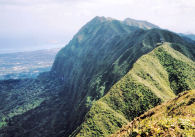 Wet cliffs in the Ko'olau Mountains provide refugia for species of rare plants.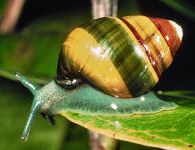
The bulk of the species of the endangered genus Achatinella are found in the lowland wet system of the Ko'olau conservation area.
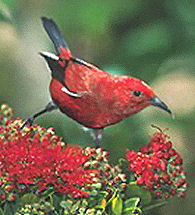
Although not a rich forest bird site, the wet forest of the Ko'olauconservation area supports common endemic birds such as this 'apapane (Himatione sanguinea).
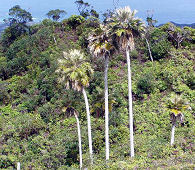
The flora of O'ahu boasts a high percentage of island-level endemism. Pritchardia martii is a palm found only in the Ko'olau Mountains.
Ko‘olau Conservation Area Profile
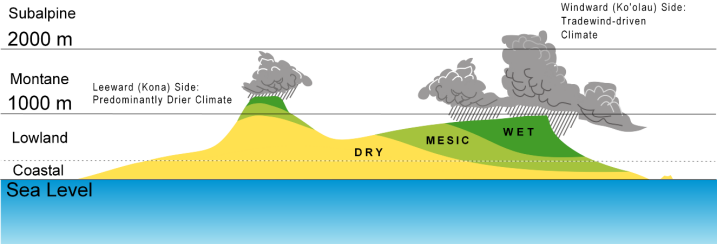
Major Habitat Type: Tropical Moist
Stratification Unit:O‘ahu (comprised of the single island of O‘ahu, see below)The island is noted for a high level of botanical endemism.
Island: O‘ahu; the third largestisland of the archipelago, ca 2.2 million years old, maximum elevation Ka‘ala, Wai‘anae Mountains, 1,220 m(4,003 ft). Bearing two conservation areas: Wai‘anae and Ko‘olau (maximum elevation, Konahuanui, 946 m (3105 ft),corresponding to the two main shield volcanoes that comprise theisland. Most populous island in the archipelago, with >85% of thestate's human population.
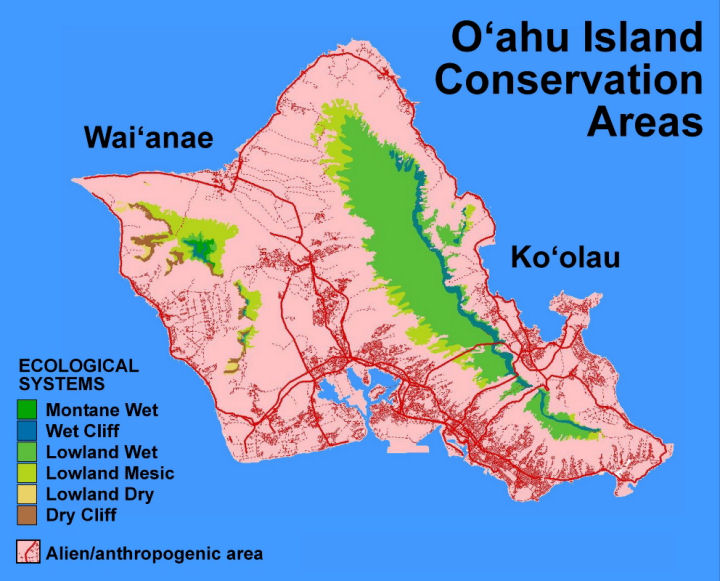
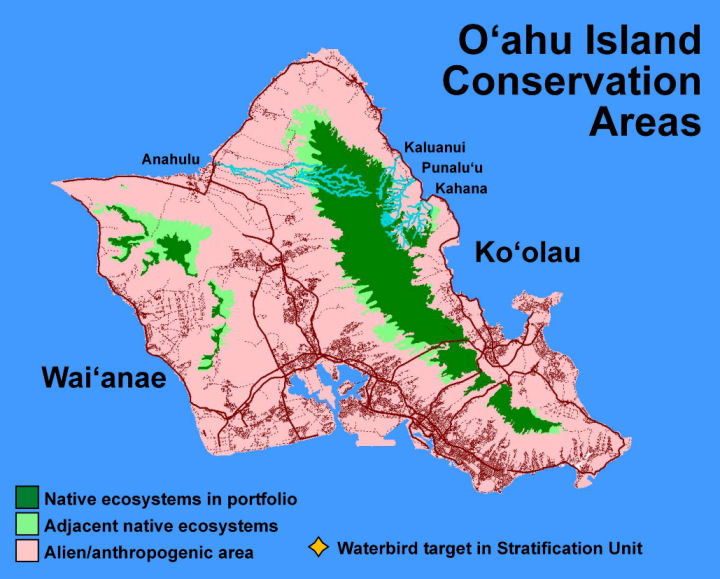
Significance: TheKo‘olau Conservation Area is comprised of lowlandto near-montane ecological systems. The remote summit area maintains viable systems, isa vitallyimportant watershed, comprises headlands for continuous perennial streamcommunities, and provides habitat for nested nativenatural communities and species. Rich in endemic species of flowering plants.
ConservationStatus: The Ko‘olau Conservation Area is protected and managed by acombination of private and public protected areas, including the O‘ahu Forest National Wildlife Refuge, the State Forest ReserveSystem, and the state Conservation District. These and other lands are in the Ko‘olau Mountains Watershed Partnership. Active conservation management is also underway via the Army's Ecosystem Management Program,involving endangered species and habitat across the Wai‘anae andKo‘olau conservation areas. Such actions are included in adiscussion of conservation strategies for O‘ahu.
A Conservation Action Plan for the Ko‘olau Conservation Area has not yet been drafted.
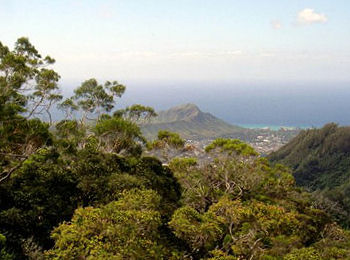
Native Lowland Wet Forest, Wa'ahila Ridge, above Honolulu, O'ahu
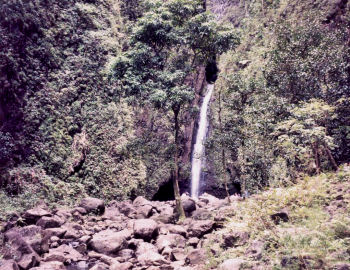
Hawaiian Continuous Perennial Stream, Kaluanui, Ko'olau Mountains
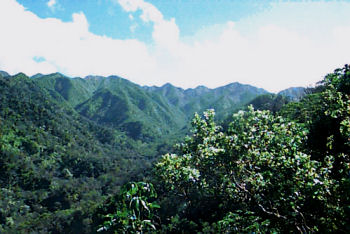
Thesummit region of the Ko'olau Mountains is rugged, undeveloped, andnative-dominated. The prevailing ecological system is Lowland Wet.
Conservation Targets:
Ecological Systems: Two ecological systems of the Ko‘olau Conservation Area were selected as conservationtargets, each bearing nested natural communities and species (discussedbelow).
| System | Size | Condition | LC | Overall |
| Lowland Wet | VERY GOOD | FAIR | POOR | FAIR |
| Wet Cliff | FAIR | FAIR | FAIR | FAIR |
Natural Communities:
- Continuous Perennial Stream Community
Special Ecological Features:
- Waterbird Concentration
- Natural Communities:
Uluhe Lowland Wet Shrubland
‘Ōhi‘a/Mixed
Koa/‘Ōhi‘a Lowland Mesic
Mixed Fern/Shrub Wet Cliff Community
Mixed Shrub Dry Cliff Community
- Native species:
There are manyconstituent native species that comprise the natural communities of the ConservationArea. Highlights include over 40 rare/endangered plant species, over 200 endemicplant species, and an untold number of endemic invertebrate species likelynumbering in the thousands.
Major Threats:Uncontrolledferal ungulates (primarily pigs); and a large variety ofinvasivealien plants, including Christmas berry (Schinus terebinthifolius), alien grasses, Koster's curse (Clidemia hirta), and strawberry guava (Psidium cattelianum). Alien grasses in dry settings contribute to a significant wildfire threat.