This page last revised 05 December 2007 -- S.M.Gon III
Introduction
Ecoregion
Conservation Targets
Viability
Goals
Portfolio
TNC Action Sites
Threats
Strategies
Acknowledgements
▫
Tables
Maps & Figures
CPT Database
Appendices
Glossary
Sources
 One of the world's wettest regions lies in the Kaua'i montane system.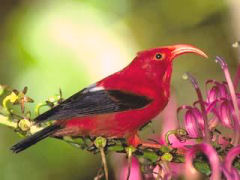
The 'i'iwi (Vestiaria coccinea) is abundant in the forests of the Kaua'i Conservation Area.
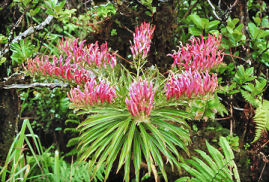
The flora of Kaua'i boasts a high percentage of island-level endemism.
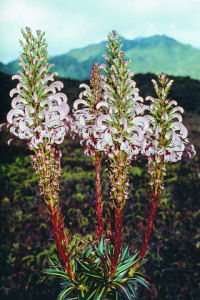
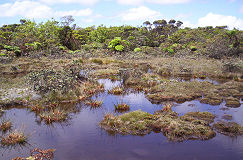
Kaua‘i Lobelia in Hawaiian Lowland Bog.
Kaua‘i Conservation Area Profile
Major Habitat Type: Tropical Moist
Stratification Unit:Kaua‘i (comprised of the islands of Kaua‘i and Ni‘ihau: islands of similargeological age). Kaua‘i Island in particular is noted for a high level of botanical endemism.
Island: Kaua‘i; the fourth largestisland of the archipelago, ca 5.5 million years old, maximum elevation 1598 m(5,243 ft), comprised of a single native-dominated landscape.
Significance: The Kaua‘i Conservation Area's ecological systems range from lowland to montaneelevations. The remote summit area maintains high viability systems, is animportant watershed, and provides stable habitat for native forest birds, and manynatural communities and species. No other conservation area in Hawai‘i contains as many endemic species of flowering
plants (383 species). Kaua‘i also has a significant number ofviable, endemic bird species (12 species) and natural community types(36 types).
ConservationStatus: The Kaua‘i Conservation Area is protected and managed by acombination of private and public protected areas, including the Kuia StateNatural Area Reserve, the Alaka‘i Wilderness Preserve, the State Forest ReserveSystem, and the state Conservation District. In late 2007, TNC's Wainiha Preserve was established within The Kaua‘i Watershed Alliance (KWA).The KWA is comprised of the above lands and selected lands ownedand/ormanaged by Kamehameha Schools; Princeville Corporation; Departmentof Water of the County of Kaua‘i; Kaua‘i Ranch, LLC; LihueLand Company; McBryde Sugar Company, Ltd.; State Department of Land andNatural Resources; Grove Farm Company, Incorporated; and Ben A. DyreFamily Limited Partnership. KWA drafted a management plan that implementsfencing, ungulate control, and weed control, ignoring land jurisdictionboundaries. The Nature Conservancy coordinates plan implementation as a major action of its Kaua‘i strategies.
For more detailed information, contact the Kaua‘i Program of The Nature Conservancy of Hawai‘i.
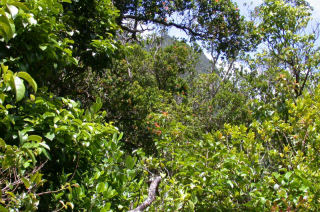
Lowland Wet Forest, Lumaha‘i Valley, Northern Kaua‘i
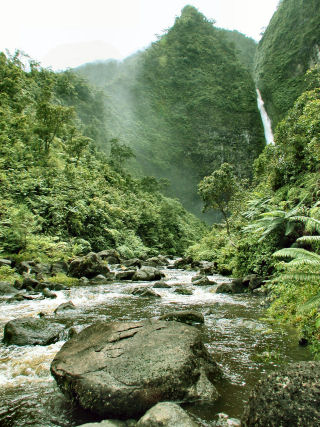
Hawaiian Continuous Perennial Stream, Wainiha Valley, Kaua'i
Conservation Targets:
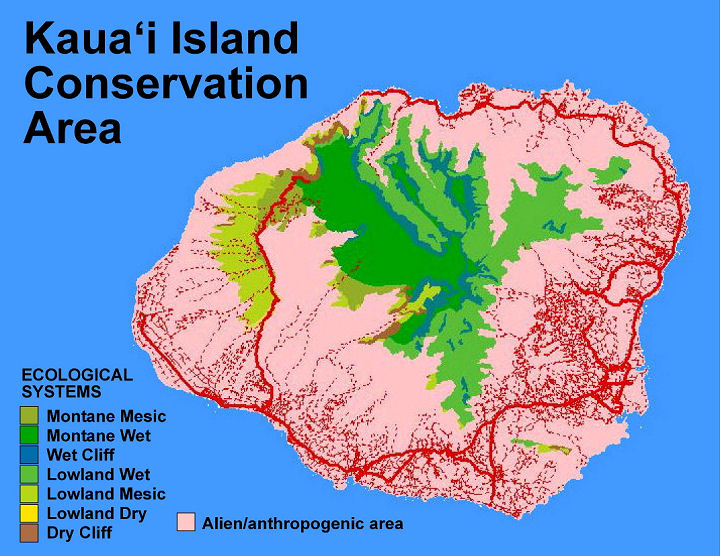
Ecological Systems: Sixecological systems of Kaua‘i were selected as conservationtargets, each bearing nested natural communities and species (discussedbelow).
| System | Size | Condition | LC | Overall |
| Montane Wet | GOOD | VERY GOOD | VERY GOOD | VERY GOOD |
| Montane Mesic | FAIR | FAIR | GOOD | FAIR |
| Lowland Wet | VERY GOOD | POOR | FAIR | FAIR |
| Lowland Mesic | GOOD | FAIR | FAIR | FAIR |
| Dry Cliff | FAIR | FAIR | GOOD | FAIR |
| Wet Cliff | FAIR | VERY GOOD | VERY GOOD | GOOD |
Natural Communities:
- Continuous Perennial Stream Community
Special Ecological Features:
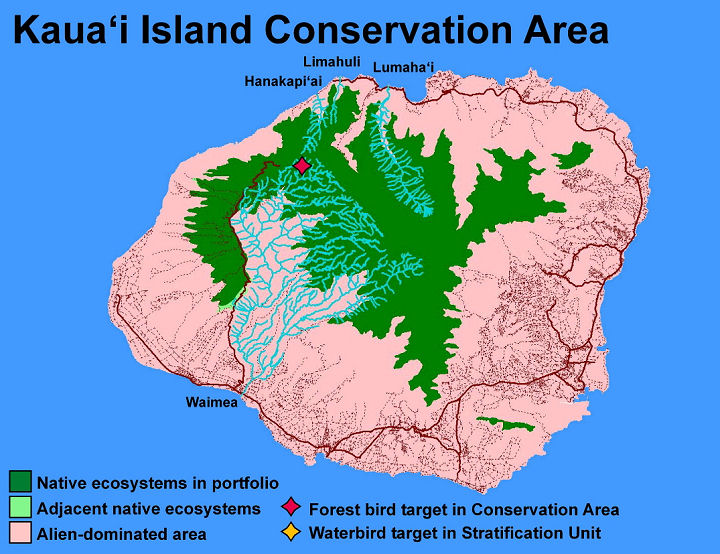
- Forest Bird Concentration
- Waterbird Concentration
- Natural Communities:
‘Ōhi‘a/Mixed
‘Ōhi‘a/Mixed Shrub Montane
‘Ōhi‘a/‘Ōlapa Montane
Koa/‘Ōhi‘a Montane Mesic
Kaua‘i Diverse Mesic
Hawaiian Montane Bog
Hawaiian Lowland Bog
Mixed Fern/Shrub Wet Cliff Community
Mixed Shrub Dry Cliff Community
- Native species:
There are manyconstituent native species that comprise the natural communities of the ConservationArea. Highlights include over 80 rare/endangered plant species, 383 endemicplant species, and an untold number of endemic invertebrate species likelynumbering in the thousands.
Major Threats:Uncontrolledferal ungulates (primarily pigs, goats, deer); and a large variety ofinvasivealien plants, particularly following hurricane ‘Iniki in 1991.Noteably, Kaua‘i is the only major island without mongoose (Herpestes auropunctatus), an important alien predator of native birds.