This page last revised 30 August 2006 -- S.M.Gon III

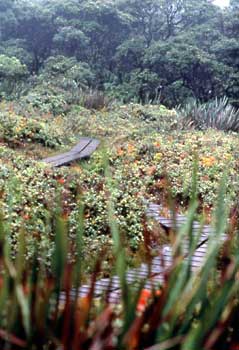
Pepe‘opae bog lies in Kamakou Preserve.
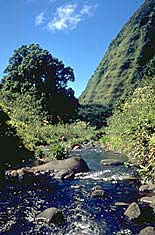
Pelekunu is one of the most intact freshwater stream communities in the ecoregion.
Appendix:
Moloka‘i Strategies
1998 ERP Strategic Summary
The 1998 ERP summarized strategies for thespecific needs of each ofthe conservation areas defined by the large native landscapes ofeach major island. The directives established then have largely beenrealized and continue to evolve. In 1998, the Moloka‘i Program, themost mature in the state, was comprised of three preserves (Kamakou,Pelekunu, and Mo‘omomi). The ERP recommended thefollowing for Moloka‘i:
- Workingwith our existing community and agency partners and the private landowners eastof Kamakou Preserve, our first step will be to establish a shared vision ofwhat should be protected on Moloka‘i.
- Withthat vision established, we will help establish a set of shared,measurable goals for bringing better protection from ungulates andtop-priorityweeds to lands within the four existing managed areas (KalaupapaNHP, Pu‘u Ali‘i NAR, Oloku‘i NAR, & TNCPreserves) andthe highest-quality native ecosystems east of Kamakou.
- We will also promote a community plan to prevent the introduction ofnew, known weeds and other disruptive invasive species to the island, inconjunction with a pilot program sponsored by the

2006 Strategic Update
By the end of 2005, The East Moloka‘i Watershed Partnership was implementing its management plan, which calls for major fencing andungulate control projects east of Kamakou Preserve. Broad communitysupport for the plan was assured by extensive community involvement inthe management plan, though small, but vocal opposition in thelocal hunting community remains.
The establishment of a Moloka‘i division of the Maui InvasiveSpecies Committee (MoMISC), and intimate integration of MoMISC staffwithin the TNC Moloka‘i baseyard has maximized alignment of alienspecies prevention goals and actions.
The Moloka‘i Program continues to manage Kamakou Preserve (2,774 acres), Pelekunu Preserve (5,759 acres), and Mo‘omomi Preserve (921 acres) in addition to its East Moloka‘i Watershed Partnership participation. All are part of the East Moloka‘i Conservation Area, for which a Conservation Action Plan (CAP) has been drafted.